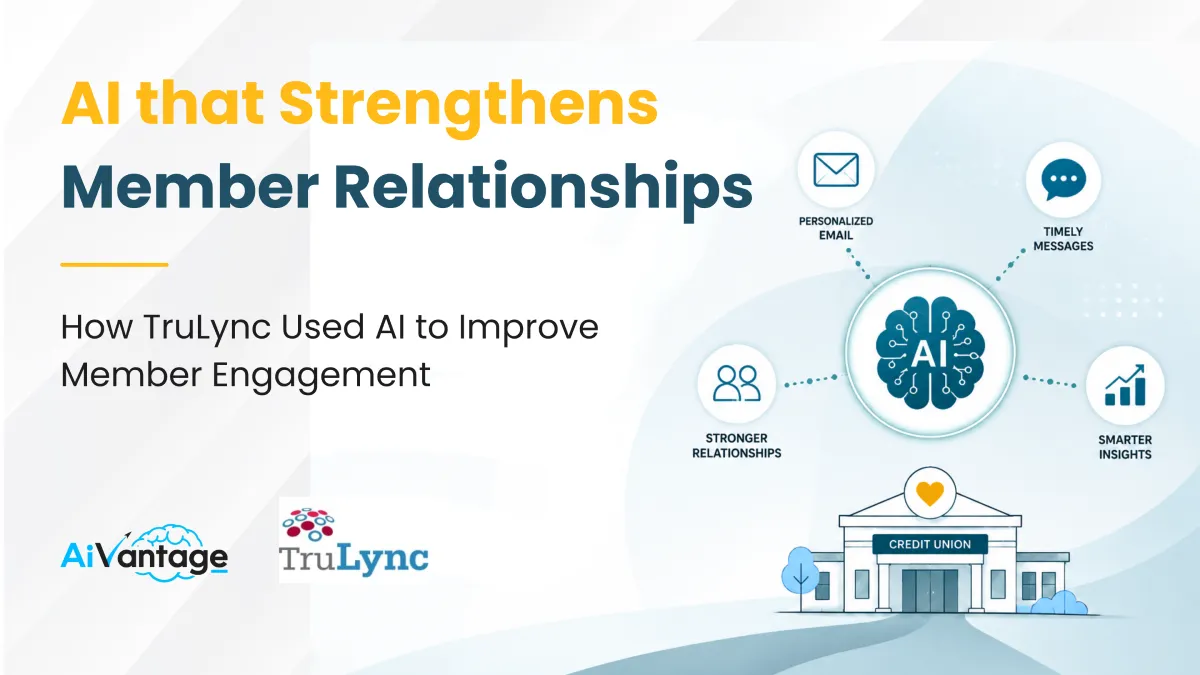
TruLync’s Story: An Example of Why Credit Unions Need AI and Innovation

Artificial Intelligence (AI) can sometimes feel overwhelming. Many credit unions know they should be exploring AI, but the question is often: Where do we start?

Many credit unions believe AI adoption requires a massive investment, a complete technology overhaul, or a team of data scientists. In reality, the most successful AI projects often begin with a single business challenge.

The institutions seeing the greatest success are asking simple questions:

  • How can we improve member communication?
  • How can we deliver more personalized experiences?
  • How can we help our staff become more efficient?
  • How can we better serve members while controlling costs?

AI is helping answer these and many more questions every day. The urgency is growing. Members are already using AI in their personal lives. Younger generations increasingly rely on AI for financial education, research, and decision-making. At the same time, banks and fintechs are rapidly expanding their AI investments.

Credit unions cannot afford to sit on the sidelines. The good news is that credit unions do not need to transform everything overnight. The best approach is to start small, define clear success metrics, and build momentum from there.

We bring you the story of TruLync, a subsidiary of the Minnesota Credit Union Network (MNCUN), helping credit union members navigate Medicare decisions. The challenge for them was to find a way to reach thousands of eligible members with the right information at the right time without creating additional work for credit union marketing teams.

This is where AI became part of the solution.

Using AiVantage’s InteractiveAI, an AI-powered 1:1 hyper-personalization platform, they launched member communication campaigns across participating credit unions. The platform helped create personalized messaging based on member data while maintaining compliance and keeping the process simple for participating institutions.

Tara Graff, Chief Marketing Officer at the Minnesota Credit Union Network, explains, “Credit unions have always succeeded because of the trust they build with members. InteractiveAI helped built communications that helped us not replace that trust, but augment and scale it – something very important for credit unions to achieve to survive”

The results were impressive. During the 2025 pilot program, approximately 22,000 emails were delivered with an average open rate of 34.5% and an unsubscribe rate of only 0.05%. All four participating credit unions saw significant increases in Medicare-related leads and member engagement.

When these results were shared with other Minnesota credit unions, they created momentum. What started as a pilot with just four credit unions grew to more than 18 credit unions, all utilizing AI to streamline member communication and better serve their members.

The most important takeaway is that all of this was achieved without complex system integrations, expensive technology projects, or large internal AI teams. Credit unions were able to start with a focused use case and quickly see measurable value.

Karan Bhalla, CEO of AiVantage, says, “Today’s members increasingly expect their financial institutions to understand their needs and deliver relevant guidance at the right moment. That’s why we built AiVantage and InteractiveAI—to help credit unions identify the right AI use cases and realize measurable value across their member journeys.” The lesson for credit unions is simple: start with one use case, focus on member value, and take the first step. Those credit unions that start today will be best positioned to serve tomorrow’s members.

To learn more about Trulync’s success story and its partnership with AiVantage in driving member engagement, download the webinar recording here: https://aivantage.tudos.tech/case-study/

The Ladder to Hyper-Personalization: From Data to Connection

For credit unions, member relationships have always been built on trust, empathy, and personal connection. But today, most member interactions happen online-not across a branch desk. That means your ability to “know” and engage members now depends on how effectively you use data and technology to recreate that personal touch in the digital space.

Around the world, leading financial institutions are already showing what personalization is possible with data. Bank of America’s ‘Erica’ delivers AI-powered financial insights and reminders uniquely tailored to each customer’s spending habits. Commonwealth Bank of Australia uses its ‘Customer Engagement Engine’ to process millions of data points in real time-offering contextual messages and proactive recommendations exactly when customers need them. And Bank of Ireland, often referred to as the ‘Netflix of Banking,’ uses predictive analytics to recommend the right financial products at precisely the right moment in a member’s life.

These examples prove what’s achievable when financial institutions combine data, empathy, and technology to anticipate-not just respond to-member needs.

And yet, while many credit unions have embraced segmentation and basic personalization, very few have climbed the ladder to true hyper-personalization-where every message feels individually crafted, emotionally relevant, and perfectly timed. Let’s see how this ladder looks to assess what’s the next step for you:

Step 1: Mass Messaging – One Message for All

“Apply for a personal loan today!”
(Same message sent to everyone.)

This is where most marketing begins: one-size-fits-all campaigns. They’re simple to send but often irrelevant. At this stage, communication is broad, generic, and fails to connect emotionally or contextually. The goal is to spread awareness-but recognize it’s the least effective form of engagement.

Step 2: Segmentation – Speaking to Groups

“Young professionals like you can get the financial boost you need with our personal loans. Apply today!”
(Targeted to a segment, like age or profession.)

Segmentation groups by shared traits such as age, income, or lifestyle. It’s a step toward relevance, but it still assumes everyone within a segment has the same needs or motivations. It delivers targeted relevance to a group using their broad demographic or behavioral data.

Step 3: Personalization – Addressing the Individual

“Dear John, at 30, it’s the perfect time to plan your financial future – apply for a personal loan today.”
(Adds name and demographic detail for a personal touch.)

Here, marketing becomes more individual like adding names, milestones, and product interests. It feels friendlier, but it’s still limited to static information, not dynamic insights or life moments. It builds familiarity and warmth, but understand personalization here remains surface-level.

Step 4: Hyper-Personalization – Connecting Emotionally and Contextually

Dear John, congratulations on your recent promotion! As a 29-year-old young professional living in Austin, we noticed you’ve been consistently growing your savings over the past year. You’ve earned this next step -upgrade your car or invest in your dream home with a personal loan built just for you. Start your loan application today!”
(Uses life event, emotion, and timing to connect deeply.)

This is the top of the ladder-where data, emotion, and intelligence meet. Hyper-personalization uses AI and behavioral insights to adapt messages in real time, based on individual context, timing, and emotion. It delivers intelligent, emotionally aware communication that builds long-term trust and loyalty.

AiVantage’s InteractiveAI enables this transformation for credit unions by analyzing multiple data points-from transaction history to digital engagement-and automatically generating content that feels human, empathetic, and relevant. It empowers credit unions to go beyond surface-level personalization and deliver 1-to-1 experiences at scale, across email, SMS, mobile apps, and digital channels.

Why Hyper-Personalization Matters Now

Today’s members interact with their financial institutions primarily through digital channels-apps, websites, and chat-not inside branches. That means the moments that once defined the member relationship are now happening on screens.

Hyper-personalization is how credit unions can bring back that human connection-digitally. It transforms every interaction from a one-way campaign into a meaningful conversation that reflects each member’s unique journey.

With solutions like InteractiveAI, credit unions can achieve the same level of intelligence and empathy as the world’s leading banks but with the agility, integrity, and community values that make them different.

Hyper-personalization isn’t a technology you install, it’s a journey you build, step by step, message by message, member by member. It requires unified data, smart automation, and a commitment to using AI responsibly.

Most credit unions are already on the ladder. The next step, hyper-personalization powered by Interactive AI, is within reach. Because when personalization becomes truly hyper, members stop feeling like accounts and start feeling like relationships again.

Ready to climb the ladder? Book a demo today and see how InteractiveAI can help your credit union connect like never before.

Is Your Credit Union Ready for AI?

A Readiness Assessment Using the 5 P’s Framework

AI is rapidly changing the way financial institutions engage with members, optimize operations, and grow their impact. Whether it’s streamlining collections, delivering personalized member experiences, or detecting fraud in real time-AI is reshaping the credit union and banking space.

But before investing in tools or talent, one critical question remains: Is your organization truly ready for AI?

To help answer that, we’ve developed a proven AI readiness framework tailored specifically for credit unions and banks-the 5 P’s: Purpose, People, Platforms, Processes, and Policies.

  1. Purpose: What Are You Trying to Solve?

AI should never be a solution in search of a problem. Start by identifying the top strategic goals that AI can accelerate.

For financial institutions, this often includes:

Ask yourself:
Are your AI plans tied to clear business outcomes-like deeper member relationships, faster onboarding, or better cross-selling?

  1. People: Do You Have the Culture and Capabilities?

Your workforce is your biggest asset-and the key to AI success.

Assess whether:

  • Teams understand AI’s role in their day-to-day work
  • There’s an appetite for experimentation and innovation
  • Training programs are in place to upskill staff (especially in marketing, lending, member service)
  • You have AI champions in departments like data, operations, and digital transformation

Financial institutions don’t need armies of data scientists—but they do need people ready to adapt.

  1. Platforms: Is Your Data Ecosystem AI-Ready?

In banking, AI is only as good as your data. Siloed systems and outdated infrastructure are major roadblocks.

Check for:

  • Unified member data across core, CRM, online banking, call centers, and marketing platforms
  • Cloud readiness and data pipelines that can support real-time analytics
  • Clean, structured data that can be used to train AI models
  • Scalable architecture (APIs, automation tools) to embed AI into workflows

If data is the new oil, platforms are your refinery.

  1. Processes: Can AI Plug Into Your Workflows?

Even the smartest algorithms won’t help if your internal workflows are outdated, manual, or inconsistent.

Evaluate:

  • Which member touchpoints (loan applications, service calls, marketing messages) are ready for intelligent automation?
  • Are processes standardized across branches and channels?
  • Can your teams act on AI insights without reengineering everything?

For example, a loan origination system that’s fully digital will adopt AI faster than a paper-based one.

  1. Policies: Are You Governance- and Compliance-Ready?

In a highly regulated industry, responsible AI is non-negotiable.

Ensure:

  • Data privacy and member consent policies are crystal clear
  • You have a framework to manage AI bias, transparency, and auditability
  • Compliance teams are involved early in AI planning
  • Vendors and tools meet regulatory expectations (e.g., NCUA, CFPB, FFIEC)

Trust is everything in financial services—especially when AI is making or influencing decisions.

Ready to Assess Your Readiness?

AiVantage helps credit unions and banks like yours evaluate AI readiness and take action.
Whether you’re just getting started or looking to scale, we make the process simple and strategic.

👉 Book a readiness consultation or demo Interactive AI today

From Data to AI: The Transformation Journey of Small and Mid-Sized Financial Institutions

Change is nothing new in the financial services industry, but the last two decades have brought rapid transformation. Small and mid-sized financial institutions (FIs) have shown resilience by adapting to new technologies, ensuring they stay relevant in a competitive market. History shows that their survival often depends on how quickly they adopt innovations like data analytics and Artificial Intelligence (AI). Those that don’t evolve face the risk of being merged, acquired, or phased out.

We document this journey—from the early days of using data to the era of AI-driven innovation. This exploration will help you evaluate where your financial institution stands in this evolution. If your institution isn’t keeping pace, now is the time to fast-track your transformation before it’s too late.

2008-2012: The Dawn of Data Awareness

The 2008 financial crisis revealed the urgent need for better transparency, risk management, and smarter decision-making. During this time, small and mid-sized FIs began to view data not as a byproduct of operations but as a valuable asset for stability and growth.

A 2010 report by the National Credit Union Administration (NCUA) emphasized the importance of data-driven insights in understanding customer behaviors, managing risks, and ensuring financial resilience. However, during this period, data often remained siloed and underutilized.

Key questions emerged:

  • What data do we have, and how can it be organized?
  • How can we use data to better serve our customers and manage risks?

This period set the foundation for a data-centric culture, with institutions establishing basic data collection practices and reporting capabilities.

2013-2015: Turning Data into Actionable Insights

Between 2013 and 2015, small and mid-sized FIs began transitioning from data awareness to actionable analytics. This shift was driven by rising customer expectations and growing competition.

A 2014 report by McKinsey & Company highlighted the growing role of data analytics in driving strategic decisions across financial services. This period saw advancements like:

  • Using descriptive analytics to analyze past performance and trends.
  • Segmenting customers to deliver more personalized marketing.
  • Introducing dashboards for real-time operational insights.

As noted in The Financial Brand (2014), analytics became a cornerstone for improving customer experiences and streamlining processes. Institutions recognized that data could be more than a static asset; it could be a driver of growth.

2016-2021: The Age of Predictive Modeling and Data Science

From 2016, small and mid-sized FIs began adopting predictive modeling and data science. These tools enabled them to anticipate customer needs and risks, shifting from reactive to proactive strategies.

A 2018 study by the Filene Research Institute emphasized the role of predictive analytics in enhancing customer engagement and managing risks. Key developments during this period included:

  • Predicting loan defaults, customer churn, and fraud using advanced models.
  • Using data science for deep personalization of services.
  • Building interactive dashboards for real-time decision-making.

By leveraging predictive analytics, FIs gained the ability to forecast trends, optimize operations, and create tailored customer experiences, giving them a competitive edge in a rapidly changing market.

2022 and Beyond: The AI Revolution

AI has become a transformative force for small and mid-sized FIs, evolving from a futuristic concept to a practical tool for improving services and operations.

According to a 2022 report by Deloitte Insights, AI adoption in financial services has grown rapidly, with institutions leveraging it for:

AI is no longer just about efficiency—it’s about creating meaningful, proactive experiences that build trust and deepen relationships.

Final Verdict: Adapting to Stay Ahead

The journey from data awareness to AI-driven transformation shows that staying strong and innovative drives the success of small and mid-sized financial institutions (FIs). By using data and AI, they’ve made smarter decisions, personalized services, and gained a competitive edge.

However, the story doesn’t end here. The next chapter in this transformation journey offers even more exciting possibilities:

  • Generative AI for delivering personalized financial advice at scale.
  • Real-time analytics for instant, data-driven decision-making.
  • Automation for seamless, efficient, and error-free operations.

To thrive, FIs must embrace change, adopt new tools, and focus on innovation. Those who adapt will shape the future of financial services, ensuring a bright future and long-term success. Ready to embark on your AI journey? Contact us today and let’s build the future together!

Taking Customer Interactions from Ordinary to Extraordinary with Hyper-Personalization: A Recap of AiVantage’s Webinar

In today’s fast-paced digital world, where customers expect personalized experiences, AiVantage hosted an insightful webinar in August, focusing on the future of customer engagement through hyper-personalization. Presented by Karan Bhalla (CEO) and Suchit Shah (COO), the session explored how AI-powered tools like AiVantage’s InteractiveAI are transforming traditional marketing efforts and delivering VIP-level experiences to customers at scale.

The Evolution of Customer Journeys

Karan kicked off the webinar by tracing the evolution of customer engagement, from the Industrial Revolution’s mass production era to the present-day demand for hyper- personalized interactions. He mentioned, “We’ve moved from the era of mass production to where customers now expect VIP experiences. It’s no longer enough to send generic messages; today, it’s all about real-time, personalized interactions that resonate with each individual customer.

Generic Marketing No Longer Works

This critical issue was addressed with alarming statistics. According to a study by Gartner, 38% of customers are at risk of leaving a brand due to poor personalization efforts. Additionally, with 21% higher reply rates achieved through just 1-2 follow-ups, the speakers emphasized that persistence combined with personalization is key to customer engagement.

Traditional, one-size-fits-all email campaigns are quickly losing their effectiveness. Karan emphasized that personalized email content significantly boosts engagement, demonstrating that hyper-personalized communication is the future. In contrast, businesses sticking to generic messaging struggle with higher customer acquisition costs and declining loyalty.

The Power of Hyper-Personalization

Hyper-personalization takes customer engagement to the next level by utilizing AI and data analytics to create individualized interactions. 80% of customers are more likely to make a purchase from a company that offers personalized experiences, according to industry research.

Hyper-personalization drives significant improvements in customer engagement. Companies using personalized emails reported generating 17% more revenue than those using generic campaigns. This highlights the financial impact of personalization,showing that hyper-personalized marketing not only boosts conversion rates but also maximizes return on investment (ROI).

Interactive AI: A Personalization Powerhouse

The webinar showcased AiVantage’s flagship product, InteractiveAI, which enables businesses to deliver dynamic hyper-personalized customer interactions at scale. By leveraging real-time data, advanced algorithms, and AI-driven insights, InteractiveAI crafts unique experiences for each customer, boosting engagement and satisfaction.

InteractiveAI has the ability to integrate seamlessly with existing systems, offering features like anomaly detection and real-time segmentation while prioritizing data privacy and compliance with industry standards. Ethical AI is a big focus. Karan stressed, “Ethical AI or ethical use of information is something we stand by. We make sure that when talking to clients, we’re very focused on representing things in the most accurate manner. AI has a lot of concerns, and we’ve built technology and safeguards to ensure it is used in the best possible manner.” This makes it easier for businesses to scale personalized experiences while maintaining customer trust.

The 5C Module: Structuring Personalization

Suchit explained, “Our evolution is shaped by our interactions with each other and the ecosystem. Today, we’re not just aiming to satisfy in these interactions; we’re driven by the desire to amaze.” This concept introduces the 5C Module, a core framework supporting hyper-personalization. The 5C Module offers a structured, automated solution that enables businesses to optimize their personalized campaigns effectively:

  1. Collect: Gathers and analyzes customer data from various touchpoints.
  2. Curate: Organizes the collected data to generate actionable insights.
  3. Craft: Tailors hyper-personalized content based on the insights.
  4. Comply: Ensures regulatory compliance and ethical use of customer data.
  5. Communicate: Distributes personalized messages across multiple channels, maintaining consistency and maximizing engagement.

This automated solution allows businesses to efficiently manage their personalization strategies, resulting in improved customer retention and higher conversion rates.

The SHIELD Framework

Karan emphasized, “You can’t hide from AI today. Take the time to explore how it can work in your organization but know that AI will likely impact every process you have.” To conclude, he introduced the SHIELD Framework, which stands for:

  • Scale with AI to personalize interactions for large audiences.
  • Hyper-personalize messages to match customer’s preferences.
  • Innovate with Interactive AI by & cutting-edge AI to boost engagement.
  • Ensure protection of customers’ data and privacy.
  • Leverage multi-layered security to safeguard data with robust measures.
  • Drive delivery of personalized experiences across multiple channels.

By combining AI-driven personalization with strong data protection protocols, the SHIELD Framework ensures that businesses can scale their marketing efforts without compromising on security or customer trust.

Future Outlook: The Rise of Hyper-Personalized Interactions

As AI and data analytics continue to evolve, the future of all customer interactions across all segments will be shaped by hyper-personalization. The webinar emphasized that businesses that fail to embrace this trend risk falling behind. In the future, every interaction will be driven by real-time data, ensuring that customers receive highly relevant and personalized experiences at every touchpoint.

For companies looking to boost customer loyalty, increase conversion rates, and improve ROI, the path is clear—hyper-personalization is no longer optional, it’s essential.

If you missed the webinar, contact us for a recording at info@aivantage.global. To learn more about InteractiveAI and how it can transform your business, contact us today.

Setting the AI Trend: Essential Positions Banks Should Fill Today

To effectively integrate AI into banking operations and stay ahead in the competitive landscape, banks need to hire key positions that are critical for developing, implementing, and managing AI technologies. Here are the positions that banks should prioritize:

  1. Chief AI Officer (CAIO)

A Chief AI Officer is responsible for overseeing the bank’s AI strategy. This role involves coordinating AI initiatives across departments, ensuring alignment with the bank’s overall goals, and managing AI-related investments and resources. By having a dedicated CAIO, banks can ensure that their AI projects are strategically directed and well-supported.

  1. Data Scientists

Data scientists play a crucial role in analyzing large datasets to derive actionable insights. They develop algorithms and models for AI applications such as predictive analytics, customer segmentation, and risk management. Their expertise is essential for transforming raw data into valuable business intelligence.

  1. Machine Learning Engineers

Machine learning engineers are tasked with designing and implementing machine learning models that can learn and adapt over time. They work closely with data scientists to deploy AI algorithms into production, ensuring that the models are scalable, efficient, and effective.

  1. AI Ethics Officer

An AI Ethics Officer ensures that the bank’s AI applications are developed and used ethically. This role involves creating guidelines for ethical AI use, monitoring compliance with these standards, and addressing issues related to bias, fairness, and transparency in AI systems. By having an AI Ethics Officer, banks can build trust with customers and stakeholders by demonstrating a commitment to ethical AI practices.

  1. Cybersecurity Specialists

Cybersecurity specialists are vital for protecting AI infrastructure from cyberattacks. They implement security measures for AI systems, monitor for threats, and respond to incidents to safeguard sensitive data. Their role is crucial in maintaining the trust and security necessary for successful AI integration.

  1. Customer Experience Designers

Customer Experience Designers focus on integrating AI into customer interactions to enhance the user experience. They design AI-driven interfaces, chatbots, and personalized services that improve customer satisfaction and engagement. By enhancing the way customers interact with the bank, these designers play a key role in driving customer loyalty and retention.

Moving Forward with AI Projects

Starting early with AI in the banking sector involves developing a strategic vision, investing in training, building a robust data infrastructure, initiating pilot projects, and fostering a culture of innovation. Hiring the right talent is equally crucial. By bringing in above experts, banks can successfully enter the AI revolution and drive significant business growth. Embracing AI today will position banks for a future of enhanced efficiency, customer satisfaction, and competitive advantage. If you’re ready to move ahead with your AI projects but lack the necessary resources, AiVantage is here to help you get started.

Navigating the Financial Landscape in 2024: Ushering in a New Era of Tech, Talent, and AI

[vc_row][vc_column][vc_custom_heading text=”Introduction:” font_container=”tag:h4|text_align:left” use_theme_fonts=”yes”][vc_column_text]As we step into the financial landscape of 2024, the industry is poised for transformative changes fueled by technological advancements, an evolving talent landscape, and the integration of artificial intelligence (AI). In this blog post, we’ll explore key trends shaping the financial sector in the United States, with a specific focus on use cases that highlight the intersection of technology, talent, and AI.[/vc_column_text][vc_custom_heading text=”Tech Trends:” font_container=”tag:h4|text_align:left” use_theme_fonts=”yes”][rt_list_style list_icon_test=”07211237-4fca-2″]

  1. Blockchain Revolutionizing Transactions:
    Blockchain technology continues to redefine financial transactions, ensuring increased security, transparency, and efficiency. Use cases include:Smart Contracts for Seamless Agreements: Smart contracts are automating and self-executing agreements, reducing the need for intermediaries and streamlining processes.
  2. Quantum Computing for Advanced Analytics:
    Quantum computing is emerging as a game-changer in the financial industry, enabling faster and more complex data processing. Key use cases include:Risk Assessment and Portfolio Optimization: Quantum computing facilitates intricate risk assessments and dynamic portfolio optimizations, enhancing decision-making processes.

[/rt_list_style][vc_custom_heading text=”Talent Dynamics:” font_container=”tag:h4|text_align:left” use_theme_fonts=”yes”][rt_list_style list_icon_test=”07211237-4fca-2″]

  1. Rise of FinTech Experts:
    The demand for talent in financial technology (FinTech) is skyrocketing. Institutions are leveraging FinTech experts for:Innovative Product Development: FinTech professionals play a crucial role in developing and launching innovative financial products and services.
  2. Data Scientists Driving Insights:
    The financial industry is increasingly relying on data scientists to extract meaningful insights from vast datasets. Use cases involve:Predictive Analytics for Investment Strategies: Data scientists are developing predictive models to enhance investment strategies, enabling more informed decision-making.

[/rt_list_style][vc_custom_heading text=”AI Integration:” font_container=”tag:h4|text_align:left” use_theme_fonts=”yes”][rt_list_style list_icon_test=”07211237-4fca-2″]

  1. Chatbots Enhancing Customer Interaction:
    AI-driven chatbots are becoming essential in providing seamless customer service. Use cases include:24/7 Customer Support: AI chatbots offer round-the-clock customer support, answering queries, and providing assistance without human intervention.
  2. Fraud Detection and Prevention:
    AI is playing a pivotal role in identifying and preventing fraudulent activities within the financial sector. Key use cases involve:Real-time Fraud Monitoring: AI algorithms monitor transactions in real-time, swiftly detecting and preventing fraudulent activities.

[/rt_list_style][vc_custom_heading text=”Conclusion:” font_container=”tag:h4|text_align:left” use_theme_fonts=”yes”][vc_column_text]The financial industry in 2024 is characterized by a dynamic interplay of technology, talent, and artificial intelligence. Embracing these trends not only ensures operational efficiency and risk management but also positions institutions at the forefront of innovation. By recognizing the potential of blockchain, harnessing the skills of FinTech experts and data scientists, and integrating AI for enhanced customer experiences and security, financial institutions are well-positioned to thrive in this new era.[/vc_column_text][/vc_column][/vc_row]