Agentic predictive analytics for financial services: The missing link between insight and action

This article was originally published on CUInsight. Read the full article Here.

Over the past decade, the financial services industry—banks, credit unions, and fintechs—has invested heavily in predictive analytics. From credit scoring and underwriting to fraud detection and customer segmentation, predictive models now power critical decisions.

The numbers reflect that maturity. More than 70% of large banks rely on predictive models for credit and risk decisioning, while fraud systems analyze millions of transactions per second globally.

But here’s the real question: if prediction is so advanced, why does action still feel slow, manual, and inconsistent? A system can flag a risky transaction. It can identify a customer about to churn. It can surface a high-probability cross-sell opportunity.

And yet what happens next? Nothing—the system waits on us.

The truth: Insights are everywhere, but execution is not

Financial institutions today operate on a powerful analytics backbone:

  • Credit models estimate probability of default
  • Fraud systems detect anomalies in real time
  • Marketing models predict customer intent and behavior
  • Wealth platforms forecast engagement and portfolio trends

These systems produce sophisticated outputs (risk scores, alerts, forecasts) but they are typically delivered through dashboards, reports, or alerts.

From there, the process slows down. An analyst interprets the data. A business team decides what to do. Operations teams execute the action.

Each step introduces delay, dependency, and inconsistency.

In a world where customers expect instant loan approvals, real-time fraud protection, and hyper-personalized experiences, this raises an uncomfortable question: Why are we still relying on fragmented, manual workflows after generating real-time insights?

The problem: The last-mile gap

The gap between insight and action is where the real inefficiency lies. An insight does not equate to a decision, and a decision does not equate to action.

Insight ≠ Decision | Decision ≠ Action

In financial services, this gap has tangible consequences:

  • A fraudulent transaction is flagged but not blocked in time
  • A high-value customer shows churn signals but no immediate outreach follows
  • A qualified borrower waits hours or days for approval

Even the most accurate prediction loses value if action is delayed. This “last-mile gap” creates:

  • Latency in time-sensitive decisions
  • Dependency on analysts and operations teams
  • Inconsistent decisioning across channels
  • Missed revenue opportunities due to slow response

The industry has optimized for prediction but not for action.

The shift: Agentic predictive analytics

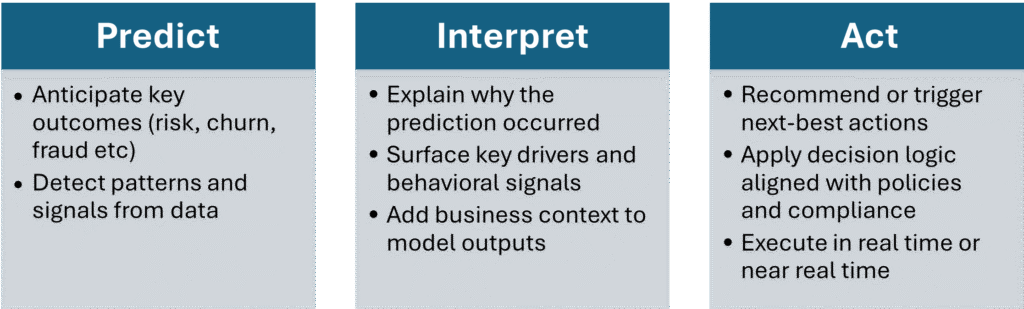
What if a system didn’t just tell you what will happen but also what to do next, and execute it? Agentic Predictive Analytics closes this gap by transforming analytics into a continuous loop of predict → interpret → act

What does this look like in practice?

  • A suspicious transaction isn’t just flagged, it’s automatically blocked or verified
  • A customer at risk of churn receives a timely, personalized retention offer
  • A loan application is instantly approved, declined, or routed
  • A cross-sell opportunity is acted on in the moment not days later

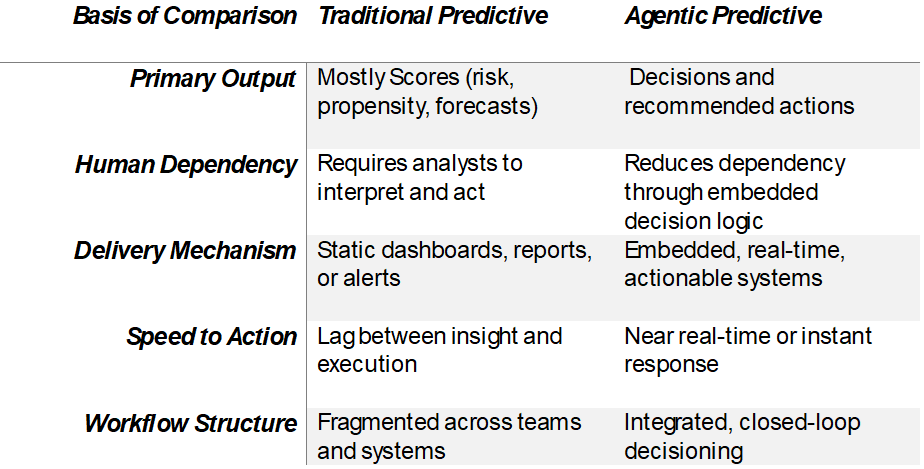
The shift from traditional predictive to agentic systems is not incremental, it’s structural:

When action becomes embedded within analytics, the impact is immediate:

  • Faster decision cycles
  • 20–30% improvement in conversion rates in AI-driven banking use cases
  • Reduced operational costs through automation
  • Consistent, scalable decision-making across channels

This data and analytics ecosystem is undergoing a natural evolution – from building models that inform decisions to systems that actively participate in them.

In financial services, prediction is no longer the differentiator. The real advantage lies in closing the gap between insight and action, ensuring every prediction leads to a decision, and every decision leads to execution.

If you want to stay ahead in this evolution of analytics with agentic predictive analytics, connect with AiVantage today.

From Reactive to Predictive with AI: Why Understanding Member Disengagement Is Critical for Credit Unions

With multiple banks and credit unions competing for the same member relationships, retention is no longer just about loyalty, it is about sustainability  and long-term growth. According to JD Power, credit union member satisfaction declined in 2026, while more members quietly expanded relationships with other institutions. In fact:

  • 59% of members now maintain checking accounts elsewhere 
  • 56% hold savings accounts outside their primary institution 

This signals a shift toward “soft switching,” where members do not formally leave but gradually reduce engagement. The National Credit Union Administration further highlights the urgency, noting that in 2025, over 55% of credit unions experienced a decline in membership, making it increasingly clear that understanding and addressing member disengagement must now be a top strategic priority for credit unions.

Why It Matters: Disengagement Is a Process, Not an Event

Member attrition rarely happens suddenly; it develops over time through subtle behavioral changes. In a relationship-driven model, value is built continuously, which also means it erodes gradually if not actively managed. Early signs of disengagement often include:

  • Fewer digital logins 
  • Declining balances 
  • Reduced transaction activity 
  • Dormant credit cards 
  • Loans paid off without follow-on engagement 

Individually, these signals may appear minor, but together they set a narrative for a weakening relationship. 

The challenge is that most credit unions view these behaviors in silos, often relying on backward-looking reports focused on past activity rather than emerging risk. Based on the traditional reporting, many institutions are able to see what changed but still struggle to determine:

  • Why it changed 
  • Whether it is meaningful 
  • What action to take 

What Is Happening: AI Connects the Dots

This is where AI introduces a far more connected predictive approach to understanding member behavior by bringing together signals that would otherwise remain isolated. 

Disengagement is rarely obvious when viewed through a single lens, and individual indicators often appear too small to warrant action; however, when analyzed collectively, they reveal patterns that tell a much more complete story.

By layering AI into this process, credit unions can shift their focus from retrospective analysis to forward-looking insight, enabling them to move beyond asking why a member was lost and instead focus on:

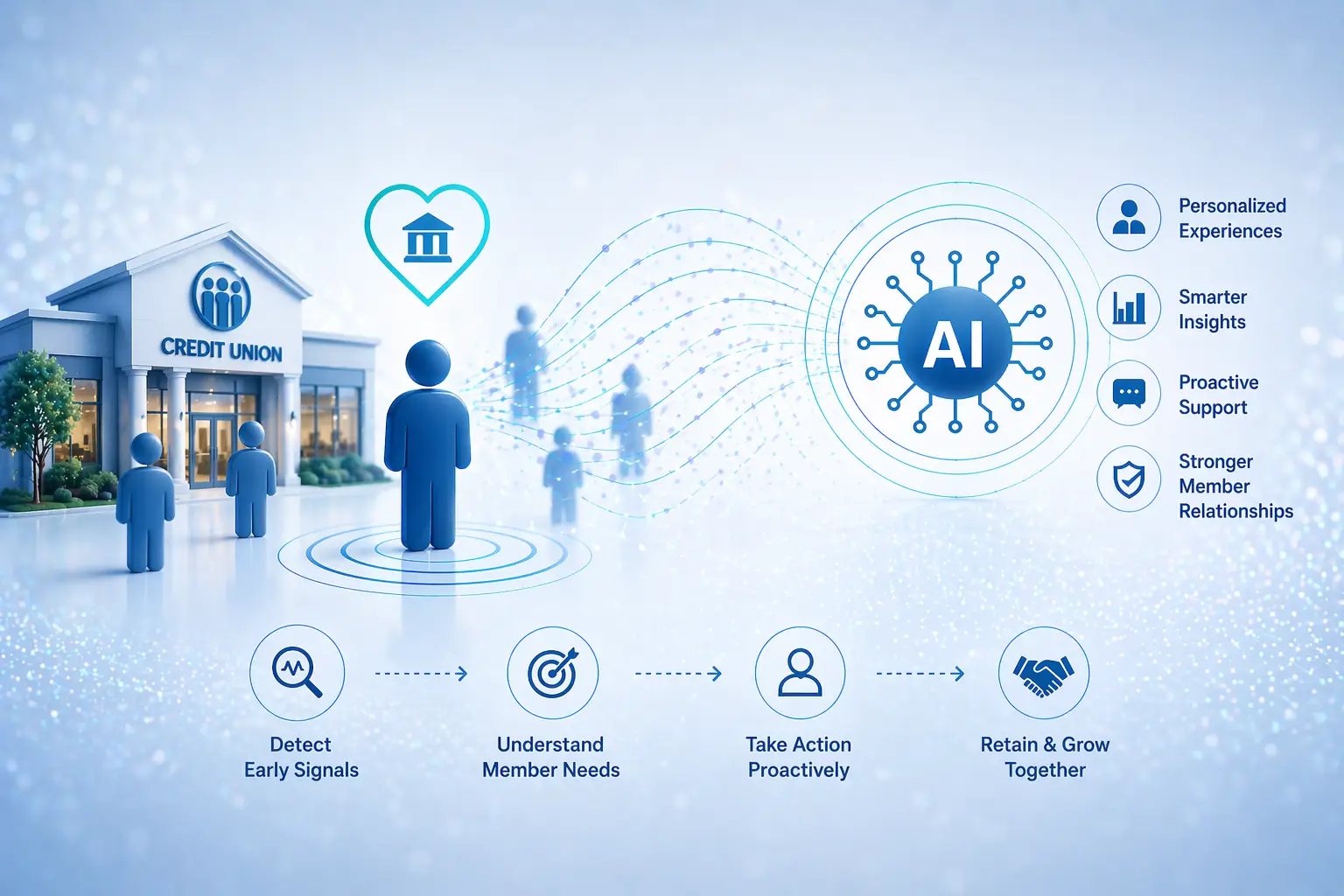
  • Which members are showing early signs of disengagement 
  • What specific behaviors are driving that risk 
  • What actions can be taken immediately

AI models can detect risk 3–9 months before churn, creating a valuable window to act.

Modern AI capabilities extend beyond prediction to explanation, translating complex data into clear, human-readable insights. Instead of relying on abstract risk scores, often difficult to interpret, credit unions gain clarity through:

  • Plain-English explanations 
  • Key drivers behind disengagement 
  • Full relationship context across products

So instead of saying Risk score of a member is 6, it tells that the member  is classified as “medium risk” because they maintain strong checking activity but show declining engagement in savings and credit card usage. This level of transparency makes insights actionable for frontline teams, not just analysts.

How to Act: From Insight to Real Engagement

Once credit unions understand both the “what” and the “why,” they can shift from reactive outreach to proactive engagement. This allows for:

  • Timely interventions aligned with member behavior 
  • Personalized offers based on actual needs 
  • Early re-engagement before relationships weaken further 

This shift is critical as member expectations are increasingly shaped by seamless digital experiences. It also transforms how different credit union teams operate:

  • Marketing: Moves from broad segmentation to behavior-driven precision 
  • Member Experience: Evolves from reactive service to proactive engagement 
  • Leadership: Shifts from reporting outcomes to influencing them 

Adopting a predictive approach does not require an immediate, large-scale transformation, but it does require a focused and structured starting point that builds momentum over time. Credit unions can begin by:

  1. Identifying member segments showing early disengagement signals 
  2. Applying predictive models to assess and quantify risk 
  3. Launching targeted, personalized engagement strategies 
  4. Measuring outcomes and refining approaches continuously 

Over time, this evolves into:

  • A self-improving retention engine 
  • More accurate risk identification 
  • Stronger and more consistent member engagement 

The Bottom Line

Credit unions are not losing members overnight, but through a gradual decline in engagement and missed early signals. The institutions that will succeed are those that can answer early and accurately what is happening, why it is happening, and how to act. Because the future of member retention is not reactive but predictive & proactive, and those that make this shift will build stronger, more resilient member relationships in an increasingly competitive landscape.

If you are a credit union looking to arrest member attrition and disengagement early, reach out to the AiVantage team today to leverage predictive intelligence and drive meaningful, personalized engagement.

AiVantage Forms New Advisory Board to Advance AI Innovation in Financial Services

Vienna, VA – February 25, 2026

The press release was originally posted on CUInsight. Read the full article here.

AiVantage today announced the formation of its new Advisory Board, a multidisciplinary group of leaders from credit unions, banks, fintechs, and enterprise organizations assembled to help guide AiVantage’s roadmap, build industry collaboration, and elevate the evolution of its ground-breaking InteractiveAI end-to-end personalization platform. InteractiveAI is one of its kind, empowering financial institutions to build meaningful, individualized personalized relationships at scale, making consumers feel heard and valued like never before.

The advisory board comes together at a time when financial institutions are moving beyond AI experimentation toward practical implementation, governance, and measurable outcomes. Welcoming the advisors, Karan Bhalla, CEO of AiVantage, said: “True & relevant innovation cannot be built in isolation. It must be shaped by real applications, foresight,  and community leadership working together. The strength of our advisory board reflects our confidence in AiVantage’s future along with the belief that the future of AI in financial services will be collaborative, responsible, and deeply human. We are honored to welcome such a qualified group of advisors to help launch us forward. “

The newly appointed members include:

  • Gitanjali Bhalla, Chief People Officer at SGH Ltd, bringing global expertise in organizational leadership, governance, and transformation.
  • Steve Bone, CEO at Member Access Processing (MAP), a veteran fintech leader with experience in digital banking and core modernization.
  • Kaushal Pandya, President & CEO of Identifi, specializing in cloud architecture and AI-driven platforms for financial institutions.
  • Melissa Pomeroy, EVP & COO at the Cooperative Credit Union Association, recognized for advancing analytics, collaboration, and data strategy across credit unions.
  • Phil Prothero, CEO of Our Community Credit Union, a community-focused executive committed to member value and operational excellence.
  • Eric Schurr, Chief Strategy Officer at Sunrise Banks and futurist advisor focused on financial inclusion and fintech partnerships.

Suchit Shah, COO of AiVantage, stressed: “Rather than going for a purely technical council, the board was intentionally designed to represent the full ecosystem AI must serve – operations, people, strategy, technology, and business impact. Each advisor on our board brings a distinct perspective that helps in our mission of breaking barriers through innovation.”

The board has already started to provide guidance on product direction, responsible AI practices, and real-world use cases, helping align innovation with operational realities and regulatory expectations across the financial services industry. AiVantage aims to set new standards for practical and ethical AI, enhancing human connection rather than replacing it with the belief that the future of financial services will be defined not just by smarter technology, but by more meaningful interactions between institutions and the people they serve.


About AiVantage

AiVantage is an innovation-driven company dedicated to empowering credit unions, banks, and financial service providers with cutting-edge AI tools, products, and services. Our flagship product, InteractiveAI, is making waves across the industry with its hyper-personalization capabilities—helping institutions craft each consumer interaction uniquely, one at a time. With a strong track record of success and deep industry insight, AiVantage is committed to helping financial institutions break barriers through innovation and stay ahead in a competitive, data-driven world.

Media Contact

Karan Bhalla

CEO of AiVantage

Karan@aivantage.org

3 Reasons Financial Institutions Need to Make People Feel Human Again

Not that long ago, financial relationships were personal. People knew who handled their mortgage. They recognized the voice at the branch. If something went wrong, they spoke to someone who understood their history and not just their balance.

Then the industry modernized at an astonishing pace. Digital banking improved access, speed, and convenience. Mobile apps replaced lines. Automation replaced conversations. While efficiency improved, something quietly disappeared: purpose and context.

Todays  financial institutions be it banks, credit unions, fintechs, and wealth platforms, are technically excellent. Payments are instant. Transfers are simple. Statements are clear.

Yet consumers still switch providers more often than ever. Financial loyalty is no longer built on functionality alone. It is built on feeling understood. Here are three reasons  why making people feel valued is critical across financial services.

  1. It’s not just about money and transactions – it’s about emotions

Financial institutions design experiences around transactions. Consumers experience them around life events.

A payment isn’t just a payment – it may be rent anxiety.
A loan isn’t just credit – it may be hope for a family milestone.
A declined card isn’t just a system rule – it may be embarrassment   in public.

When people sense the institution understands their situation, stress decreases and collaboration grows. When they feel processed instead of understood, frustration and distance grows. Research consistently shows satisfaction is driven less by product features and more by how problems are handled. People rarely remember how smoothly an app worked – they remember how the institution responded to their needs. Good technology helps, but empathy matters more.

  1. Trust is valued higher than price and product features

Most financial products are pretty similar. Interest rates trend the same way. Apps offer similar tools. Payments settle instantly almost everywhere. Consumers no longer choose mainly based on features – they choose based on confidence.

When consumers feel known:

  • They ask for advice earlier
  • They keep more accounts in one place
  • They forgive occasional errors

When they feel anonymous:

  • Every fee feels unfair
  • Every delay feels careless
  • Every competitor looks the same

Two institutions can offer the same product and still have very different retention rates. The deciding factor is not capability – it is perception of intent. People stay where they believe someone is looking out for them.

  1. Loyalty drives growth more than marketing

Acquiring financial consumers is expensive. Keeping them is invaluable.

Across banking and fintech, many new relationships now come from recommendations and online reviews rather than advertising. People do not recommend institutions because of dashboards but they recommend them because of experiences.

When recommending a financial institution – Nobody enthusiastically tells a friend: “You should try their mobile interface.”

They say: “They helped me close my home loan smoothly when I was stressed.”

That sentence carries more influence than any marketing. Feeling valued turns service interactions into stories. Stories turn consumers into advocates. Advocates lower acquisition cost and increase lifetime value. In a world where switching providers takes minutes, emotional loyalty has become the strongest retention barrier available.

The Real Takeaway

Every institution can build fast systems. Not every institution builds confidence.

Don’t let technology drive how you build relationships. Let relationships drive how you build your technology.

Making consumers feel valued is no longer a soft service philosophy – it is a real business strategy. It drives retention, trust, and long-term profitability.

At the end of the day, people don’t just stay where their money grows. They stay where they feel someone is looking out for them.

Reach out to us for a demo of InteractiveAI – an AI-powered marketing platform that creates hyper-personalized communication based on a consumer’s purpose, story, and context, helping them feel valued, seen, and heard.

Beyond borders: The credit union movement is way bigger than you think

This article was originally published on CUInsight. Read the full article here.

Attending the World Credit Union Conference (WCUC) in Stockholm this July offered a timely reminder: credit unions are not just local financial players, they are part of a global movement that has quietly built a significant presence across continents. What struck me wasn’t just the keynotes or breakouts (although those were excellent), It was the stories I heard in conversations with attendees. From Singapore to Kenya to Brazil-and yes, also right here in the U.S.-credit unions are quietly but powerfully shaping communities, one member at a time.

This year, leaders from 53 countries attended-most from Brazil, the United States, and Ireland, with substantial representation from the Caribbean and Latin America, followed by Europe, Africa, Asia-Pacific, and Australia. What a global congregation indeed! I have to commend the World Council of Credit Unions for pulling off such an event and bringing together so much diversity, while still aligning to a common mission.


A global presence with local roots

In Brazil, the Sicredi system has grown to more than 9 million members and plays a massive role in rural development. It’s not just about loans or savings-it’s about economic empowerment in regions where traditional banks rarely reach.

In Kenya, SACCOs (Savings and Credit Cooperative Organizations) are everywhere. They’ve become lifelines for farmers, teachers, and entrepreneurs-many now offering digital banking services that rival the most advanced in the West.

Singapore is home to credit co-operatives serving niche groups like police officers, civil servants, and healthcare professionals. Even in one of the world’s most advanced banking markets, these co-ops thrive because of deep-rooted community trust and service mindedness.

And then there’s the United States-a credit union giant. With more than 4,500 credit unions serving 137 million members and managing $2.2 trillion in assets, the U.S. proves cooperative finance can flourish in mature markets. During the pandemic, credit unions here offered loan forbearance, PPP loans, and hands-on support when members needed it most.

Other developed nations are equally inspiring. In Canada, the Desjardins Group serves 7 million members and leads in cooperative innovation. In Australia, mutual banks like Great Southern Bank are pushing digital transformation without losing their member-first focus. And in Germany, the Volksbanken and Raiffeisenbanken network forms part of the world’s largest cooperative financial group, providing stability and access in both urban and rural areas.

However, these cases should not be viewed as success stories alone. They also highlight the fragmented nature of the movement. Despite a shared mission, credit unions still operate in silos, often lacking the infrastructure to collaborate across borders or even regions.


One philosophy, shared by millions

What ties all these examples together is a simple philosophy: people helping people.

It’s why small community institutions in rural Canada or India can resonate with cooperative leaders in the Caribbean or South Korea. But while the spirit is strong, we’re still fragmented-and that’s a missed opportunity.

The world is facing overlapping crises-financial, social, environmental. This is the time for credit unions to come together and show what cooperative finance can do on a global scale.

What if a credit union in Kenya could share its mobile-first model with one in rural Ohio? What if a Brazilian credit union’s community development strategy could inspire one in South Africa?

This movement has the depth. What it needs now is momentum.


The real potential of AI: Beyond efficiency

As someone working closely with AI and data, I see real opportunities for credit unions-but also real limitations. While automation and cost reduction are obvious benefits, AI’s more valuable role lies in its ability to generate and act on insight. It can help us deeply understand our members’ needs-even before they speak them out loud. It can scale the kind of personalization that makes credit unions special. It can make us reconnect with our members, just the way we did when we got started.

Yet deploying AI effectively requires infrastructure that many cooperatives currently lack. This includes data cleansing, integrated data sets; skilled personnel; and ethical frameworks for implementation. Most importantly, AI should be deployed not in isolation, but as part of a shared cooperative strategy. Imagine a shared global platform where credit unions can learn from each other’s campaigns, member behaviors, or fraud patterns. Where a cooperative in the Philippines can use an AI model trained on similar members from Peru or Ghana. This kind of collaborative intelligence is not only possible-it’s needed.


Done ethically, AI is simply another way to put people first. To explore how your credit union can harness AI ethically and effectively, contact AiVantage and discover solutions built to put members first.

Barriers to deploying AI are also artificial-Here’s the proof

This article was originally published on CUInsight. Read the full article here.

For a few years now smaller financial institutions have believed that AI was only for the big players-with massive budgets, deep data science teams, and high-risk appetites. Spoiler Alert: Those barriers are just not true. Today, AI is within reach for credit unions and regional banks, and the real risk is not deploying it fast enough.

What changed and how?

Build vs. buy? The hybrid model is winning

The classic debate-build versus buy-is fading fast. Today, forward-thinking institutions are adopting a hybrid model, where they stack modular AI tools that can be quickly configured and deployed. No need to rip out legacy systems or hire an entire AI lab. Instead, you bring the strategy, and let the stack do the heavy lifting. Institutions are starting to modify their systems and software to integrate with solutions rather than large scale implementations.

This modular approach is gaining traction because it’s faster, cheaper, and more adaptable. In fact, the financial sector’s spend on AI is projected to increase from $35 billion in 2023 to $126.4 billion in 2028-not to build Frankenstein systems, but to drive agility and savings.

If that’s not a sign of confidence in hybrid, modular AI, what is?

AI is not just for automation-It’s a goldmine of insights

It’s easy to think AI is just a productivity hack-automating emails or back-office workflows. But that’s just skimming the surface. The real competitive advantage lies in insight-actionable intelligence that fuels even smarter lending, sharper marketing, and better risk management.

AI-driven credit scoring, for instance, has been shown to improve loan decision accuracy by 30% and reduce default rates by 15%. Imagine being able to confidently approve more loans with less risk. That’s what your competitors are already doing-and if you’re not, you’re bleeding opportunity.

No PhDs needed-Just a vision & strategy

Another outdated belief: that you need a bench of data scientists to make AI work. No Dr. Professor, you do not, not anymore. The tools today are built for the business user-with pre-trained models, intuitive dashboards, and built-in integrations that make AI adoption a business decision, not a tech gamble.

That’s why AI-driven investment platforms are now cutting fees by up to 50% while improving service and performance. And it’s why small teams at credit unions are seeing big returns without hiring elite talent. In other words, you don’t need a PhD-you just need a plan.

Responsible AI is being baked in

Let’s address the elephant in the room-compliance and ethics. Yes, AI once had a “black box” problem. But today’s leading vendors are embedding transparency, fairness, and data privacy right into the model’s design. Responsible AI principles are at the core of every model and product we build.

The result? Nine out of 10 companies are incorporating responsible AI principles as per a new AI Business survey. Responsible AI isn’t a feature-it’s a standard.

And for institutions navigating growing regulatory pressure and member trust issues, that peace of mind is priceless.

The clock is ticking-fast

Here’s the real takeaway: while you’re evaluating, your competitors are evolving.

Over 91% of financial institutions have already deployed or are actively testing AI-and 77% expect it to increase their revenue by more than 10% in just a few years.

This is no longer about early adoption. It’s about survival. Waiting is no longer cautious-it’s reckless. AI is more accessible than ever. It’s modular, insight-driven, ethical, and fast to deploy. Institutions just like yours are already proving it-and reaping the rewards.

At AiVantage, we help credit unions and banks demystify AI and deploy smarter, faster, and more responsibly. We’ll meet you where you are-and take you where you need to go. Let’s start today!

Will AI be the next chapter in credit unions’ growth journey?

This article was originally published on CUInsight. Read the full article here.

For decades, credit unions have navigated waves of change, adjusting to economic shifts, new regulations, and emerging technology. Those that embraced innovation didn’t just survive-they grew stronger and remained competitive.

Over the past 20 years, credit unions have moved from basic data awareness to fully integrating artificial intelligence. Each phase in this transformation has been crucial. Now, as AI reshapes financial services, credit unions must decide how they will adapt to this next major shift.

Mergers, acquisitions, and the pressure to evolve

The number of credit unions in the U.S. has declined significantly. In 1995, there were over 12,595 federally insured credit unions. By Q3 of 2023, that number had dropped below 4,645 according to data from the National Credit Union Administration (NCUA). Many merged to stay competitive, while others struggled to keep up with growing operational demands and the rise of digital banking.

Despite these challenges, credit unions that embraced technology thrived. Those that used data to improve member experiences, streamline operations, and strengthen risk management positioned themselves for long-term success.

The first shift: Data as a strategic asset (2008-2012)

The 2008 financial crisis forced credit unions to rethink how they managed risk and made decisions. During this period, data emerged as more than just a record of transactions-it became a tool for strategic growth.

2010 NCUA report highlighted the growing need for data-driven decision-making. Credit unions started implementing basic data collection systems to understand member behaviors and financial trends. However, many still lacked the technology to analyze and apply these insights effectively. While this period laid the foundation for data-driven operations, there was still a long road ahead.

From information to action (2013-2015)

As digital banking gained traction, member expectations evolved. Credit unions began using data analytics to enhance services, leading to more personalized interactions and improved operational efficiency.

Reports from McKinsey & Company during this period emphasized the competitive advantage of data-driven strategies. Credit unions started investing in tools that analyzed member behavior, allowing them to provide more targeted financial products. This marked the shift from simply collecting data to actively using it for better decision-making and service improvements.

The rise of predictive analytics (2016-2021)

By the mid-2010s, credit unions moved beyond analyzing past trends and began using predictive models to anticipate future needs. This shift helped them enhance member experiences, detect fraud faster, and improve lending decisions.

It was observed that credit unions leveraging predictive analytics saw improved member retention and risk management. Instead of reacting to financial events as they happened, credit unions started forecasting trends, allowing them to offer proactive financial solutions tailored to members’ needs.

AI: The defining innovation of this era (2022 and beyond)

Now, credit unions are entering a new phase where artificial intelligence is transforming nearly every aspect of banking. AI is no longer an emerging concept-it is actively reshaping how credit unions interact with members, manage risk, and optimize their operations.

2022 Deloitte report detailed the rapid adoption of AI-driven solutions in financial services. Credit unions are already integrating AI-powered chatbots to provide 24/7 member support, using machine learning models to improve fraud detection, and leveraging AI for more precise credit risk analysis.

Hyper-personalization has also become a reality, with AI allowing credit unions to offer financial products tailored to individual member needs. Instead of relying on broad demographic trends, AI enables institutions to understand each member’s unique financial situation and provide solutions that truly add value.

Credit unions: Adapting, growing, and looking ahead

Credit unions have faced numerous challenges over the years-mergers, regulatory changes, and digital disruption. Yet, their ability to evolve has kept them relevant and strong. From the early days of data collection to predictive analytics and now AI, credit unions have consistently adapted to better serve their members.

AI is not the final step-it’s just the next chapter. As technology continues to evolve, credit unions that stay ahead of the curve will define the future of financial services. By embracing AI, they can enhance member experiences, improve efficiency, and ensure long-term growth.

At AiVantage, we are growing as a strategic AI partner for forward-looking credit unions. Contact us today to learn how we can support your journey into the AI-driven future.
For decades, credit unions have navigated waves of change, adjusting to economic shifts, new regulations, and emerging technology. Those that embraced innovation didn’t just survive-they grew stronger and remained competitive.

Over the past 20 years, credit unions have moved from basic data awareness to fully integrating artificial intelligence. Each phase in this transformation has been crucial. Now, as AI reshapes financial services, credit unions must decide how they will adapt to this next major shift.

Mergers, acquisitions, and the pressure to evolve

The number of credit unions in the U.S. has declined significantly. In 1995, there were over 12,595 federally insured credit unions. By Q3 of 2023, that number had dropped below 4,645 according to data from the National Credit Union Administration (NCUA). Many merged to stay competitive, while others struggled to keep up with growing operational demands and the rise of digital banking.

Despite these challenges, credit unions that embraced technology thrived. Those that used data to improve member experiences, streamline operations, and strengthen risk management positioned themselves for long-term success.

The first shift: Data as a strategic asset (2008-2012)

The 2008 financial crisis forced credit unions to rethink how they managed risk and made decisions. During this period, data emerged as more than just a record of transactions-it became a tool for strategic growth.

2010 NCUA report highlighted the growing need for data-driven decision-making. Credit unions started implementing basic data collection systems to understand member behaviors and financial trends. However, many still lacked the technology to analyze and apply these insights effectively. While this period laid the foundation for data-driven operations, there was still a long road ahead.

From information to action (2013-2015)

As digital banking gained traction, member expectations evolved. Credit unions began using data analytics to enhance services, leading to more personalized interactions and improved operational efficiency.

Reports from McKinsey & Company during this period emphasized the competitive advantage of data-driven strategies. Credit unions started investing in tools that analyzed member behavior, allowing them to provide more targeted financial products. This marked the shift from simply collecting data to actively using it for better decision-making and service improvements.

The rise of predictive analytics (2016-2021)

By the mid-2010s, credit unions moved beyond analyzing past trends and began using predictive models to anticipate future needs. This shift helped them enhance member experiences, detect fraud faster, and improve lending decisions.

It was observed that credit unions leveraging predictive analytics saw improved member retention and risk management. Instead of reacting to financial events as they happened, credit unions started forecasting trends, allowing them to offer proactive financial solutions tailored to members’ needs.

AI: The defining innovation of this era (2022 and beyond)

Now, credit unions are entering a new phase where artificial intelligence is transforming nearly every aspect of banking. AI is no longer an emerging concept-it is actively reshaping how credit unions interact with members, manage risk, and optimize their operations.

2022 Deloitte report detailed the rapid adoption of AI-driven solutions in financial services. Credit unions are already integrating AI-powered chatbots to provide 24/7 member support, using machine learning models to improve fraud detection, and leveraging AI for more precise credit risk analysis.

Hyper-personalization has also become a reality, with AI allowing credit unions to offer financial products tailored to individual member needs. Instead of relying on broad demographic trends, AI enables institutions to understand each member’s unique financial situation and provide solutions that truly add value.

Credit unions: Adapting, growing, and looking ahead

Credit unions have faced numerous challenges over the years-mergers, regulatory changes, and digital disruption. Yet, their ability to evolve has kept them relevant and strong. From the early days of data collection to predictive analytics and now AI, credit unions have consistently adapted to better serve their members.

AI is not the final step-it’s just the next chapter. As technology continues to evolve, credit unions that stay ahead of the curve will define the future of financial services. By embracing AI, they can enhance member experiences, improve efficiency, and ensure long-term growth.

At AiVantage, we are growing as a strategic AI partner for forward-looking credit unions. Contact us today to learn how we can support your journey into the AI-driven future.

AI Powered Marketing in Financial Services: The Underrated Engine of Engagement and Growth

Artificial intelligence has been transforming risk, compliance, fraud detection, and operations in financial services for years. But one of the most undervalued, yet high-impact applications of AI today is marketing, particularly hyper-personalized member and customer campaigns. Far beyond simple automation, AI is enabling financial institutions to forge deeper relationships, improve campaign performance, and optimize spend with precision that traditional tools simply can’t match.

The Current Landscape

Across the financial industry, AI adoption continues to accelerate. More than 80% of financial services firms are using AI to enhance customer experience, and 63% report using it specifically to personalize offers and marketing. These numbers reflect a shift from generic messaging toward tailored engagement at scale.
Yet despite this momentum, AI’s potential in marketing still flies under the radar compared to its roles in fraud detection or underwriting. Many institutions have focused their AI investments on operational efficiency, leaving campaign personalization as an afterthought even though that’s where some of the biggest gains can be realized.

Why Personalization Matters

Consumers today expect relevance. Over half of financial service customers want personalized digital experiences, and 55% are more likely to buy when offers are tailored to them. This is not a “nice-to-have” it’s a competitive necessity.

AI unlocks personalization by analyzing massive datasets – behavioral patterns, transaction histories, digital interactions, demographic signals – in real time. With machine learning models, financial marketers can segment audiences far beyond traditional demographic buckets. They can predict next-best actions, deliver contextual content, and tailor offers that resonate on an individual level.

The impact is measurable: hyper-personalized campaigns have been shown to increase engagement by over 2.3×, while real-time personalization can lift conversion rates by more than 25%. These gains translate directly into revenue, improved customer satisfaction, and lower churn.

Optimizing Marketing Spend

One of the strongest arguments for AI in marketing is its ability to optimize spend. Instead of broadcasting the same message to every segment, AI tools allocate resources based on predicted response, customer value, and lifecycle stage. This drastically improves ROI and reduces wasted spend on underperforming campaigns.

For financial services firms, this optimization also supports cross-sell and upsell strategies a key growth driver in a crowded marketplace. AI-driven segmentation and predictive analytics help identify individuals most likely to respond to specific products, from loans to savings plans, ensuring marketing dollars are invested in high-probability conversions.

Scaling Without Compromise

AI doesn’t replace human creativity – it amplifies it. Task automation frees marketers from repetitive workflows so they can focus on strategy, storytelling, and relationship building. Meanwhile, AI continues to personalize content at scale, delivering millions of unique customer interactions with precision and compliance.

As AI adoption deepens, the gap between institutions that leverage personalization and those that don’t will widen. Financial organizations that embed AI into their marketing stack will see stronger engagement, more efficient spend, and deeper customer loyalty – outcomes that directly affect growth and competitive differentiation.

In an era where consumers expect individualized experiences, AI-powered marketing is no longer optional it’s essential. Harnessing its full potential will be a defining factor for financial brands that want not only to serve customers, but to connect with them meaningfully in every interaction. Reach us today, if you need help integrating AI in your marketing.

2025: What Is AI? to 2026: How Do We Embrace It?

By the end of 2024, majority of banks and credit unions were still exploring exactly what AI meant for them. Leaders knew the term, curious teams experimented with tools like Copilot & ChatGPT, and employees wondered: Will AI help me-or replace me?

Fast forward to the end of 2025, and the landscape has shifted. AI literacy has grown across financial institutions. Teams now better understand what AI is, executives see its potential, and pilot programs are rolling out. But awareness alone isn’t enough-the conversation has shifted to comfort, trust, and practical application within banking and credit unions.

Over the course of 2025, AiVantage organized 7 roundtables, financial leaders across the nation shared their experiences, concerns, and successes, producing a clear picture of how institutions are moving from knowing AI to being comfortable with it. From these discussions, five key insights emerged, each highlighting ways to increase confidence and build sustainable adoption:

  1. Appetite for AI varies based on role and Comfort comes from Context
    Different roles in banks and credit unions experience AI differently. Innovation and IT teams are often excited to experiment, while executives-especially in regulated areas-remain cautious. Comfort grows when AI use is clearly framed for each function, showing both potential benefits and associated risks. By connecting AI to concrete outcomes, institutions reduce fear, encourage experimentation, and foster confidence across all teams.
  2. It is Critical to Close the Training & Knowledge Gap
    Awareness of AI is no longer the main hurdle, but knowledge gaps still exist. Employees need structured education, workflow-specific guidance, and hands-on practice to feel capable and confident. When staff understand how AI integrates into daily operations-whether it’s analyzing loan applications, streamlining member services, or supporting compliance checks-they adopt tools faster, trust their outputs, and feel empowered rather than threatened.
  3. Start with Familiar Data Initiatives – Trust Follows
    Successful AI pilots in banks and credit unions often anchor on internal systems and data employees already know, such as transaction histories, account management tools, or reporting dashboards. Familiarity makes AI predictable and tangible. Early wins-like automating routine reporting or generating faster insights-build credibility, demonstrating that AI is a helpful partner rather than a disruptive force.
  4. Balancing Personalization with Privacy Builds Confidence
    AI enables highly tailored member experiences, but financial institutions operate in a tightly regulated environment. Comfort increases when teams and members see AI being applied transparently and ethically, with strong safeguards, opt-in/opt-out options, and clear explanations of how data is used. Demonstrating that AI can improve services without compromising privacy or compliance builds trust and reassures both staff and members.
  5. Human Context and Culture Readiness will make AI Stick
    AI is most effective when paired with human judgment and a supportive culture. Banks and credit unions that invest in change management, workforce training, and cultural alignment create an environment where employees feel confident using AI responsibly. Shifting from “scaling with humans and caring with tech” to “scaling with tech and caring with humans” ensures adoption strengthens institutional values, enhances member experiences, and fosters long-term comfort with AI tools.

The Bottom Line:
Across the 2025 AiVantage roundtables, a clear theme emerged: financial institutions are no longer asking what AI is-they are asking how to make AI work safely, effectively, and confidently. Comfort is the new frontier. Organizations that invest in training, familiar data, ethical personalization, and human-centered adoption will not only implement AI-they will earn trust, improve efficiency, and deliver member experiences that feel genuinely thoughtful and human.

Reach out to us to figure out how AI can work safely, effectively and confidently for you.